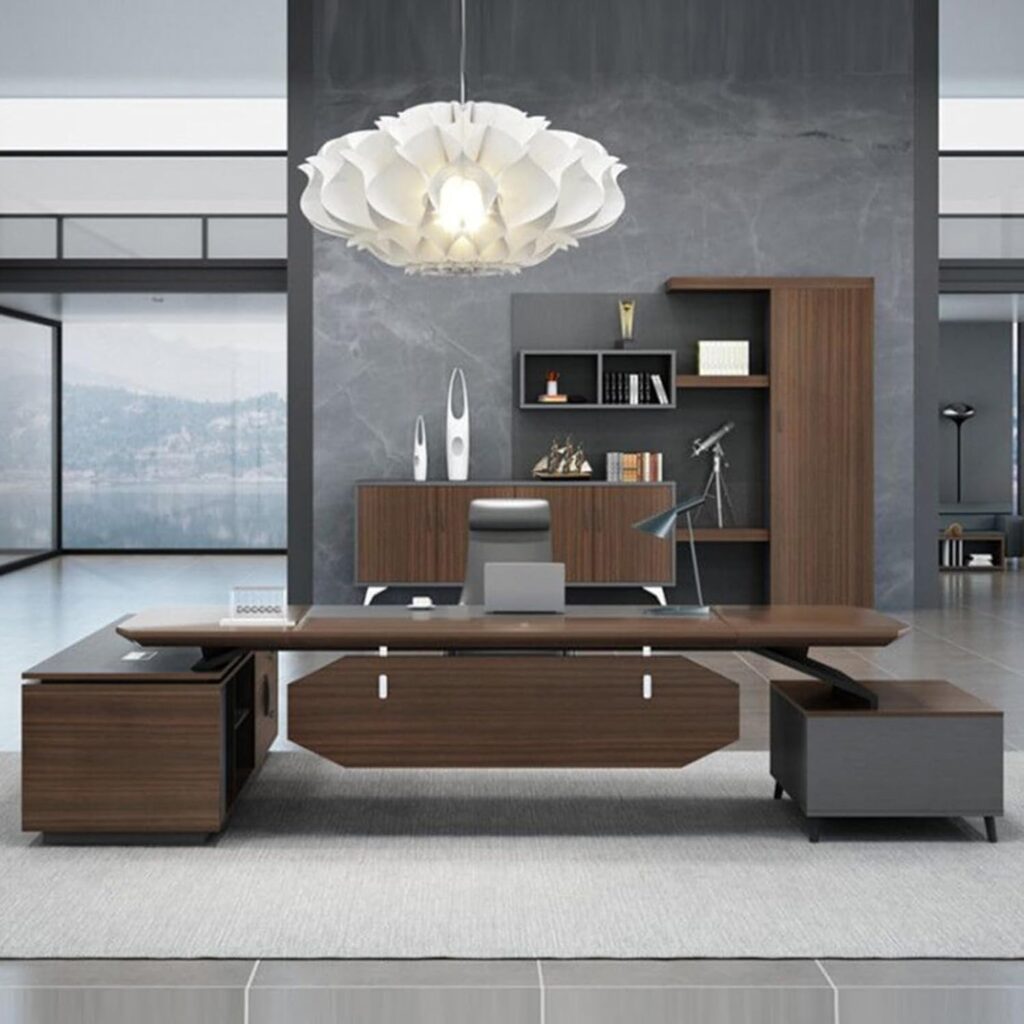
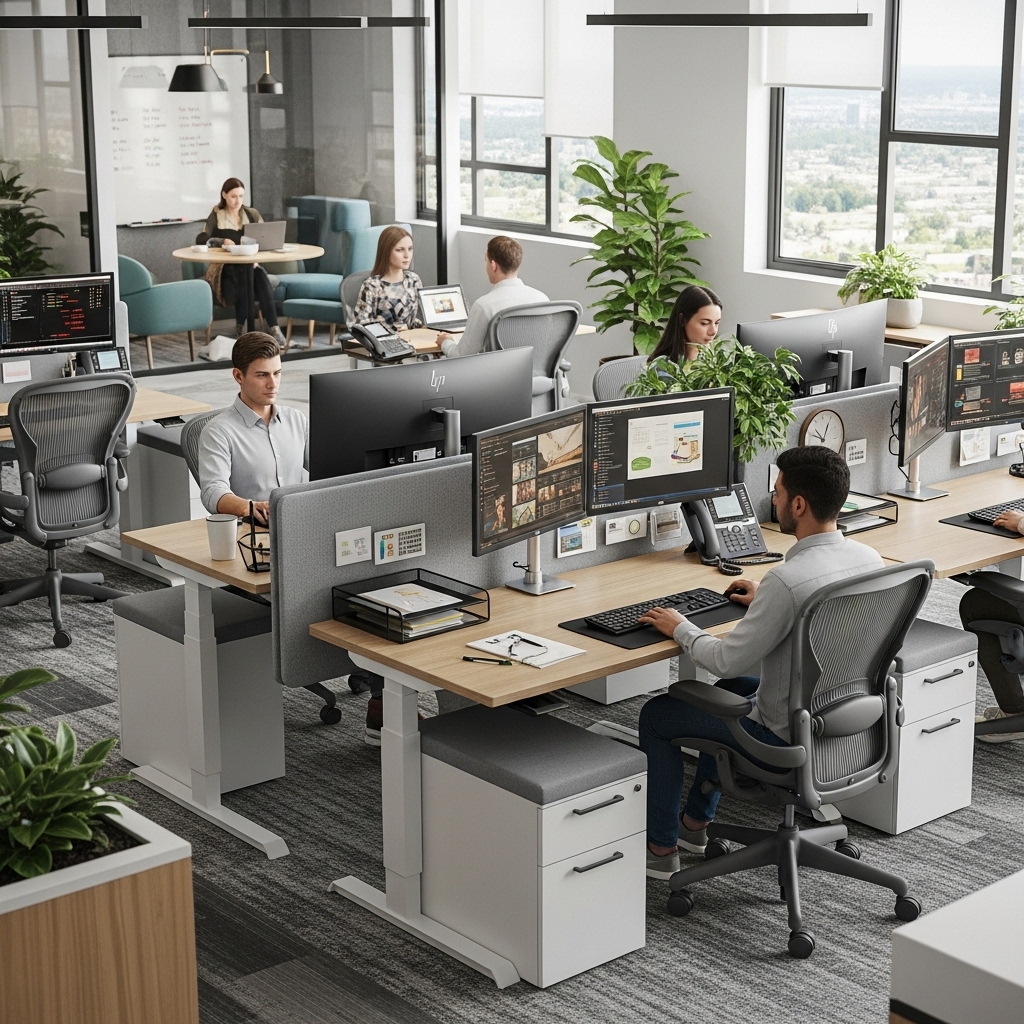
A well-planned corporate office design layout directly influences productivity, collaboration, and employee satisfaction.
The right layout balances functionality with aesthetics while supporting different work styles—from focused individual tasks to team collaboration.
Whether designing a new office or upgrading an existing space, these 14 corporate office design layout ideas offer practical inspiration for creating an efficient and professional workplace.
1. Open-Plan Office Layout
The open-plan layout is one of the most popular corporate office designs.
It removes walls and partitions to create a shared workspace that encourages communication and teamwork.
This layout maximizes natural light and makes offices feel more spacious, though it works best when paired with acoustic solutions to manage noise and maintain focus.
2. Hybrid Office Layout
A hybrid office layout combines open workspaces with private offices, meeting rooms, and quiet zones.
This flexible approach supports both collaboration and concentration, making it ideal for modern corporate environments.
Hybrid layouts are especially effective for organizations with diverse teams and varying work needs.
3. Cubicle Office Layout
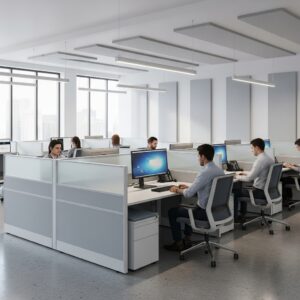
Cubicle layouts offer individual workstations separated by partitions, providing privacy and reducing distractions.
Modern cubicle designs feature lower walls, sound-absorbing materials, and sleek finishes.
This layout is well-suited for roles that require focus and confidentiality, such as finance or administrative departments.
Also check: 30 Office Lounge Interior Ideas
4. Activity-Based Working (ABW) Layout
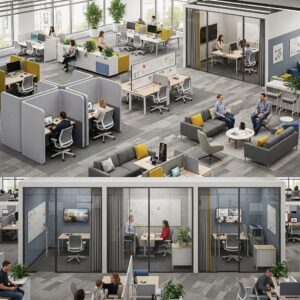
Activity-based layouts provide different zones for specific tasks, such as focus work, collaboration, meetings, and relaxation.
Employees choose where to work based on their activity rather than having assigned desks.
This layout promotes flexibility, movement, and higher engagement throughout the workday.
5. Team-Based Office Layout
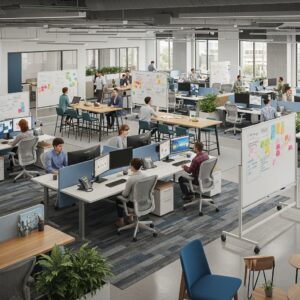
In a team-based layout, departments or project groups are assigned dedicated zones.
Workstations, meeting tables, and shared resources are placed close together to improve communication and workflow.
This layout enhances collaboration while maintaining structure within the organization.
6. Linear Office Layout
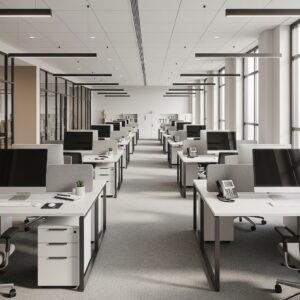
Linear layouts arrange desks, offices, and storage along straight lines, often following the shape of the building.
This design improves circulation and efficiency, making it suitable for narrow or rectangular office spaces.
Linear layouts are easy to organize and maintain, offering a clean, professional appearance.
7. Cellular Office Layout
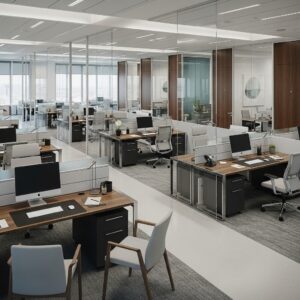
Cellular layouts consist of individual enclosed offices for employees or managers.
This traditional design provides maximum privacy and minimal noise, making it ideal for leadership roles or confidential work.
While less collaborative, cellular layouts support deep focus and formal corporate environments.
8. Flexible Office Layout
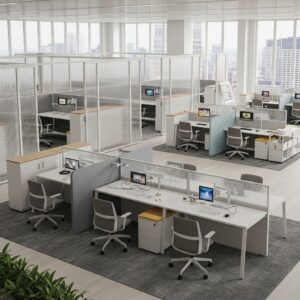
A flexible office layout uses movable furniture, modular walls, and adaptable workstations.
This allows the office to evolve as teams grow or change.
Flexible layouts are ideal for fast-growing companies and organizations that value adaptability and long-term cost efficiency.
9. Hot-Desking Layout
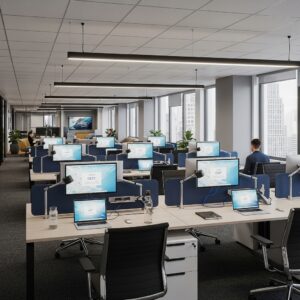
Hot-desking layouts remove assigned seating, allowing employees to choose available desks each day.
This design works well for hybrid and remote-friendly workplaces.
Hot-desking reduces space requirements while encouraging interaction among different teams.
10. Co-Working Style Office Layout
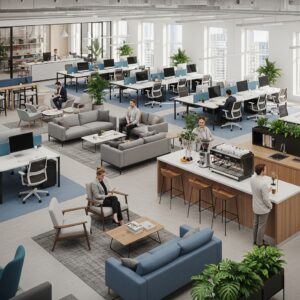
Inspired by co-working spaces, this layout blends open desks, lounges, and shared amenities.
It creates a relaxed yet professional atmosphere that fosters creativity and networking.
Co-working style layouts are popular with startups and innovative corporate teams.
11. Executive Office Layout
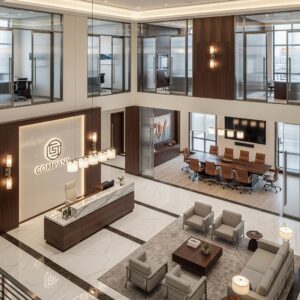
Executive layouts focus on leadership areas, including private offices, meeting rooms, and reception spaces.
These layouts emphasize professionalism, privacy, and comfort.
High-quality finishes and strategic placement help reflect authority and brand image.
12. Small Corporate Office Layout
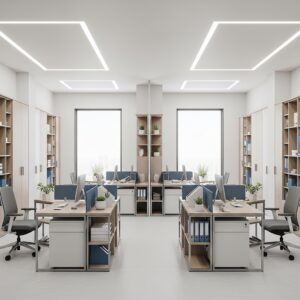
Small office layouts prioritize space efficiency through compact workstations, vertical storage, and multi-functional areas.
Smart planning ensures even limited spaces feel open, organized, and productive without sacrificing comfort.
13. Sustainable Office Layout
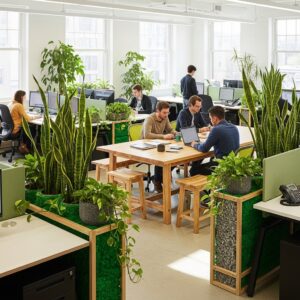
Sustainable layouts focus on energy efficiency, natural lighting, eco-friendly materials, and indoor plants.
This design improves employee well-being while supporting corporate environmental goals.
Sustainable layouts also help reduce long-term operational costs.
14. Technology-Driven Office Layout
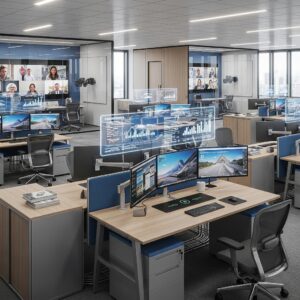
Technology-driven layouts integrate smart systems, digital meeting rooms, and tech-enabled workstations.
Cable management, charging stations, and interactive displays are strategically placed to support modern workflows.
This layout is ideal for tech-focused and future-ready organizations.
Choosing the right corporate office design layout is essential for creating a productive, comfortable, and visually appealing workplace.
From open-plan designs to technology-driven solutions, these 14 corporate office design layout ideas can be adapted to fit any company’s size, culture, and goals.