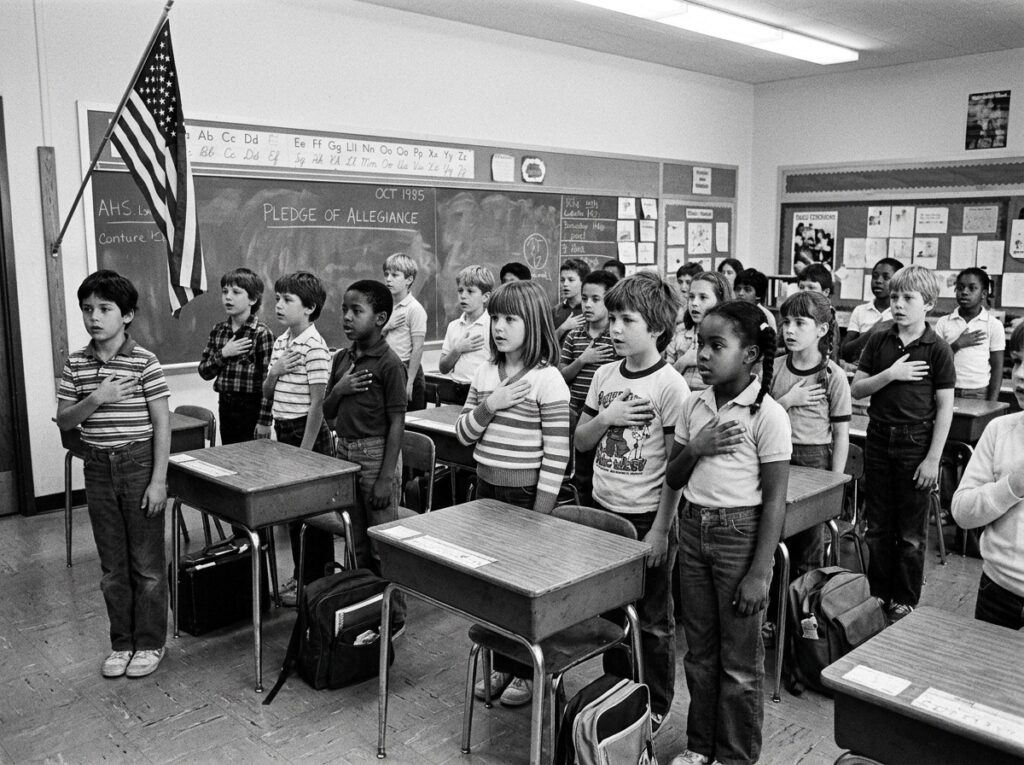
If you’ve scrolled through your feed lately, you’ve probably seen the heated debates. Someone posts a photo of an empty flagpole or a quiet classroom, and the comments section turns into a digital battlefield.
“Why did they stop?” “In my day, we stood every morning!” “The country is losing its way!”
But if we peel back the layers of viral rumors and angry memes, the truth about why some schools have shifted their stance on the Pledge of Allegiance is a lot more complex—and a lot more interesting—than a simple “yes” or “no” vote.
Let’s dive into the real reasons this American staple is changing.
1. The Supreme Court Ruled on This… in 1943 
Most people believe the “removal” of the Pledge is a recent “woke” phenomenon. In reality, the legal foundation was laid over 80 years ago.
In the landmark case West Virginia State Board of Education v. Barnette, the Supreme Court ruled that schools cannot force students to recite the Pledge or salute the flag. The Court argued that “compulsory unification of opinion” was contrary to the very First Amendment values the flag represents.
The takeaway: Schools didn’t necessarily “remove” the Pledge; they simply stopped making it a mandatory requirement to avoid violating constitutional rights.
2. The “Under God” Debate
The Pledge we know today isn’t the original version. The phrase “under God” wasn’t added until 1954, during the Cold War, to distinguish the U.S. from “godless Communists.”
For many modern schools, this phrase has become the center of a tug-of-war between religious freedom and the separation of church and state. While many students are happy to say it, schools in diverse districts often opt for a “moment of silence” instead to remain inclusive of all faiths (and those with no faith at all).
3. Cultural Shifts and “Opting Out”
We are living in an era of high political engagement. Today’s students are more likely to use the morning ritual as a form of silent protest.
Whether it’s a statement on racial injustice, government policy, or personal belief, many students choose to remain seated.
For teachers, trying to “force” the issue often leads to disciplinary headaches and potential lawsuits.
To maintain a focus on education rather than confrontation, some schools have simply de-emphasized the ritual.

4. It’s Actually a State-by-State Patchwork 
Here is the part that might surprise you: The Pledge hasn’t actually been “removed” from most places.
-
47 states still have laws on the books requiring time for the Pledge in schools.
-
However, these laws almost always include an “opt-out” clause for students and staff.
The reason you think it’s gone is often due to local school board decisions or individual classroom cultures where the teacher simply forgets or chooses to prioritize the “morning announcement” blitz instead.
Is the Tradition Dying or Evolving? 
The “Real Reason” isn’t a secret conspiracy—it’s a mix of constitutional law, religious diversity, and the changing ways young people express their patriotism.
For some, the Pledge is a sacred bond of unity. For others, true liberty means having the choice not to say it.
What do you think? Should the Pledge remain a daily staple in every classroom, or is it time for schools to move toward new ways of teaching civic duty?  Sound off in the comments—we want to hear your civil take!