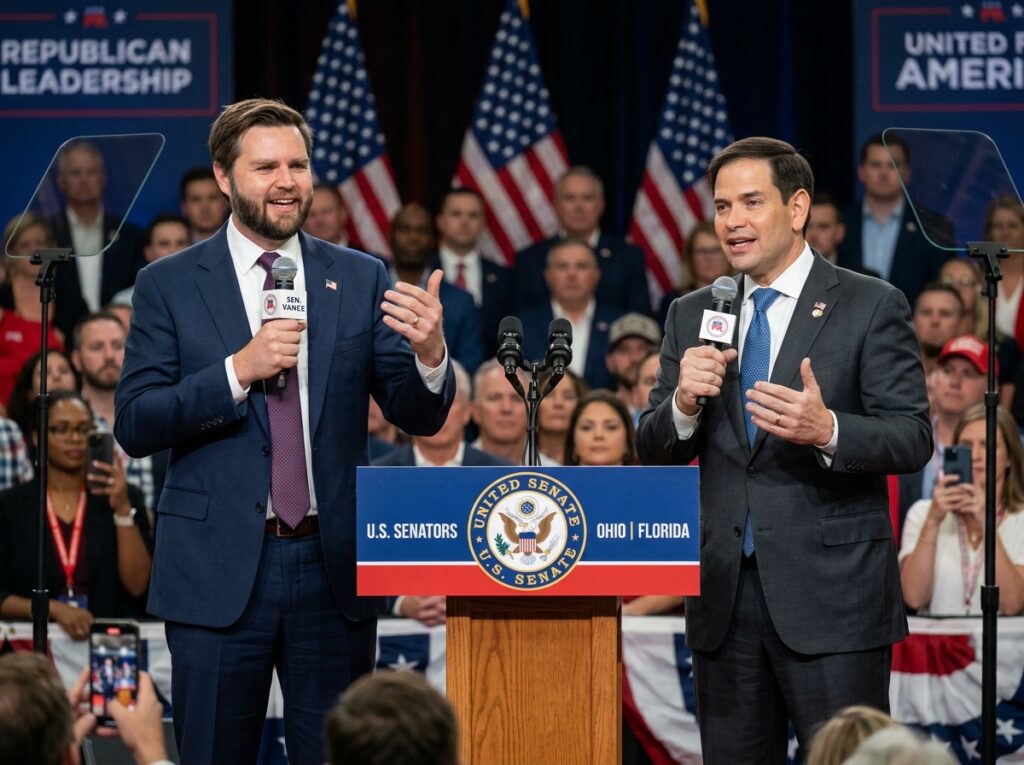
As discussions about the future of the Republican Party continue, two names frequently come up: JD Vance and Marco Rubio.
Both have become influential voices within the GOP, but they have different backgrounds, political experiences, and leadership styles.
If you’re wondering how these two Republicans compare, this guide breaks down seven key differences to help you better understand each politician.
Who Is JD Vance?

JD Vance is an American politician, author, and Marine Corps veteran.
He first gained national attention after publishing his bestselling memoir Hillbilly Elegy, which explored the economic struggles of many working-class families in Appalachia.
He later entered politics and was elected to the U.S. Senate representing Ohio.
Vance has become known for emphasizing manufacturing, border security, and economic policies aimed at supporting American workers.
Who Is Marco Rubio?
Marco Rubio is an American politician who has represented Florida in the U.S. Senate since 2011.
Before serving in the Senate, he was Speaker of the Florida House of Representatives.
Rubio also sought the Republican presidential nomination in 2016, giving him experience campaigning on a national stage.
Over the years, he has focused on issues such as national security, foreign policy, economic growth, and education.
1. Political Experience
JD Vance
JD Vance entered elected office relatively recently. His political career has largely centered on his role as a U.S. senator, making him one of the newer national figures in Republican politics.
Marco Rubio
Marco Rubio has spent many years in public office. His experience includes serving in the Florida legislature, leading the Florida House, and spending more than a decade in the U.S. Senate.
Difference: Rubio has considerably more experience in elected office than Vance.
2. Professional Background
JD Vance
Before politics, Vance served in the U.S. Marine Corps, earned a law degree, worked in venture capital, and became a bestselling author.
Marco Rubio
Rubio built his career primarily through public service and law. Most of his professional life has been spent in elected office.
Difference: Vance comes from military service, business, and writing, while Rubio’s career has focused mainly on government and public policy.
3. Economic Priorities
JD Vance
Vance frequently speaks about rebuilding American manufacturing, reducing dependence on foreign production, and supporting domestic industries.
He has argued for policies aimed at strengthening working-class communities.
Marco Rubio
Rubio also supports economic growth but often highlights entrepreneurship, innovation, small businesses, and workforce development alongside manufacturing.
Difference: While both support economic growth, Vance places greater emphasis on revitalizing industrial jobs, whereas Rubio often stresses entrepreneurship and long-term competitiveness.
4. Foreign Policy
JD Vance
Vance has generally advocated for carefully evaluating U.S. involvement overseas and has emphasized focusing resources on America’s domestic priorities.
Marco Rubio
Rubio has long been recognized for his strong interest in foreign policy.
He has consistently supported an active U.S. role in international affairs and has taken firm positions on issues involving countries such as China, Cuba, Iran, and Russia.
Difference: Rubio is generally viewed as more internationally focused, while Vance has often emphasized domestic priorities.
5. Leadership Style
JD Vance
Supporters describe Vance as direct and outspoken. He often presents himself as a voice for working-class Americans and is known for addressing economic and cultural issues in a straightforward manner.
Marco Rubio
Rubio is often seen as a policy-oriented communicator who frequently explains issues in detail.
He is known for delivering structured speeches and discussing both domestic and international policy.
Difference: Vance is often associated with a populist communication style, while Rubio is frequently viewed as more policy-focused.
6. National Recognition
JD Vance
Vance became widely known after the success of Hillbilly Elegy, and his profile has grown further through his role in national politics.
Marco Rubio
Rubio has been a nationally recognized political figure for many years, especially since his 2016 presidential campaign.
Difference: Rubio has had a longer period of national visibility, while Vance’s rise has been more recent.
7. Potential Appeal to Republican Voters
Every election is different, and voter preferences can change over time.
Some Republican voters may be drawn to Vance’s emphasis on manufacturing, border security, and working-class issues.
Others may prefer Rubio’s extensive government experience and long-standing focus on national security and foreign policy.
Ultimately, which approach resonates more depends on what voters prioritize.
Similarities Between JD Vance and Marco Rubio
Although they have different backgrounds, they also share several similarities.
Both:
- Are Republican senators.
- Support stronger border security.
- Advocate for economic growth.
- Have emphasized addressing China’s influence in global affairs.
- Have built national profiles within the Republican Party.
Which Leader Has More Experience?
In terms of years in elected office, Marco Rubio has the advantage.
His service in state government, the U.S. Senate, and his previous presidential campaign have given him a longer political résumé.
JD Vance, meanwhile, represents a newer generation of Republican leadership and has quickly become a prominent voice in national politics.
JD Vance and Marco Rubio have both become influential Republican leaders, but they bring different experiences and priorities to the political landscape.
Vance’s background in the military, business, and writing shapes his focus on working-class issues and domestic policy, while Rubio’s long career in public office has made him a leading voice on foreign policy and national security.
As with any potential future election, voters will ultimately decide which leadership qualities they value most.
Until any official presidential campaigns are announced, comparisons like these offer a useful way to understand the backgrounds, experience, and policy priorities of prominent political figures without predicting future outcomes.